


Written by Garth Phoebus
On learning, tools, and why similarity has never been theft
Every creative discipline eventually runs into the same uncomfortable truth:
There are finite building blocks.
In music, there are twelve notes.
In photography, light behaves according to physics.
In painting, shadows fall the way form dictates.
This isn’t a failure of creativity.
It’s the condition that makes creativity possible.
Yet increasingly, similarity itself is being treated as suspicion — sometimes even as moral failure. That misunderstanding isn’t just wrong. It’s dangerous to the future of art.
Shared language has never meant stolen work
Photography makes this clear.
Photographers around the world use the same poses, lighting ratios, and compositional rules. Bridal portraits look like bridal portraits for a reason. Cinematic lighting looks cinematic because it works.
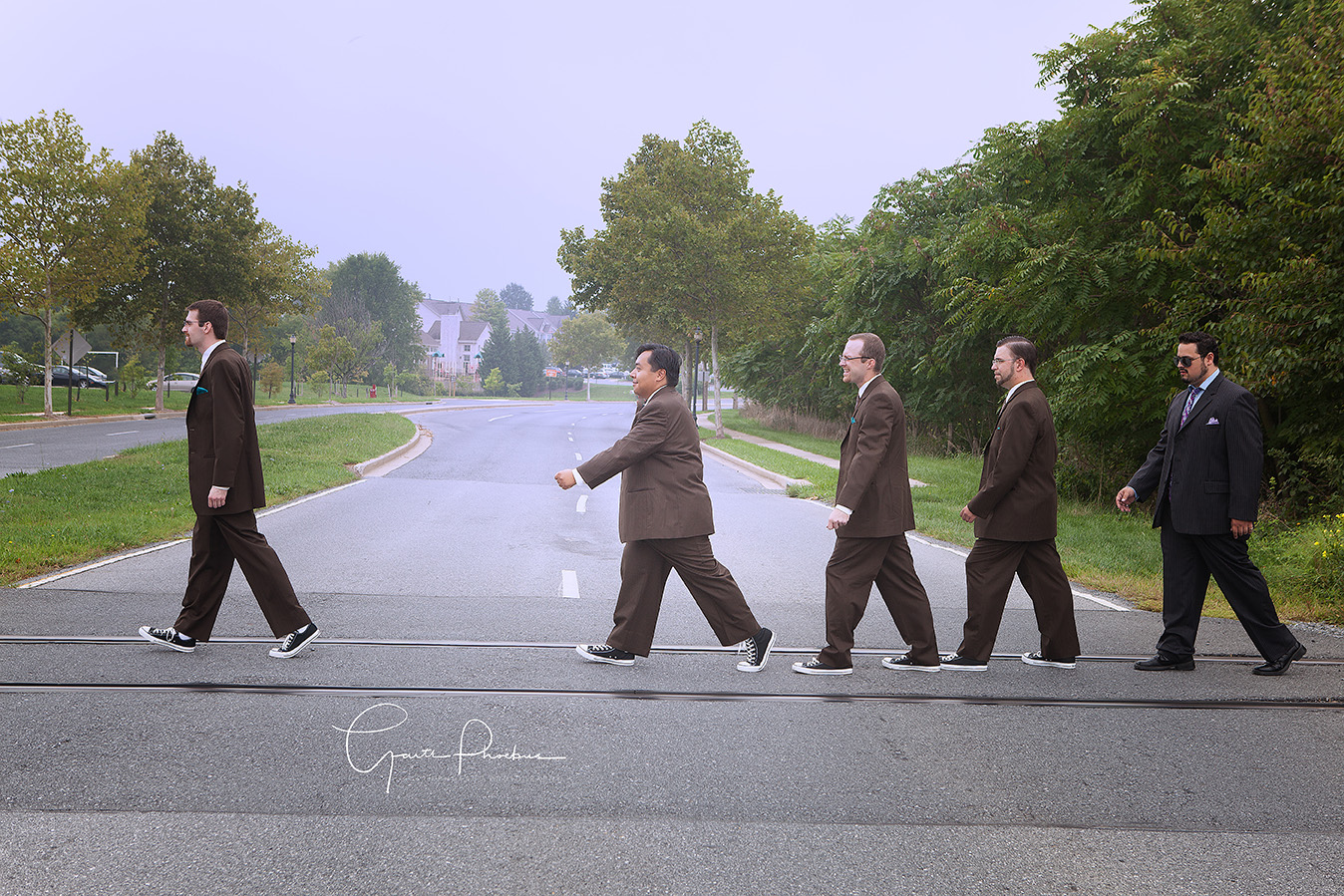
I’ve photographed weddings where the couple specifically asked to recreate the Abbey Road crossing. We did it. No one accused anyone of theft. No one confused it with the original photograph. Everyone understood the difference between a cultural reference and a copied work.
Painting works the same way.
No one accuses an artist of stealing because they use:
- chiaroscuro to create depth,
- value shifts to suggest form,
- contour lines to define planes,
- or color theory to convey mood.
My daughter recently painted a self-portrait. She didn’t invent shadows or dimensionality, yet no one would say she stole them. We call that learning how light works. We call that art education.
Music has always lived in this same reality.
Music is finite by design
There are only so many chord progressions that sound good to the human ear.
Only so many rhythmic patterns the body responds to.
Only so many melodic movements that feel emotionally satisfying.
This is why:
- the twelve-bar blues spans generations,
- the same progressions appear in thousands of songs,
- entire genres exist around shared structure.
Courts and musicologists have long understood this. That’s why copyright protects specific melodies and lyrics, not chord progressions, grooves, tempos, or genre conventions.
If similarity itself were theft, blues wouldn’t exist. Jazz would be illegal. Rock would have collapsed decades ago. Pop music would be nothing but lawsuits.
The rules didn’t change.
The tools did.
Learning is not copying
Popular music isn’t something I copy.
It’s something I learn from — the same way artists always have.
Structure.
Harmony.
Emotional pacing.
How lyrics sit against chords.
How voices stretch, fall, and resolve.
Learning how music works has never been the same as taking someone else’s song. Confusing the two doesn’t protect art — it misunderstands it.
What modern tools learn are relationships, not songs:
- how harmony supports emotion,
- how rhythm reinforces meaning,
- how musical tension resolves.
That’s grammar, not sentences.
Where authorship actually lives
When I started in photography, I didn’t understand the business, the community, or the relationships. I just created.
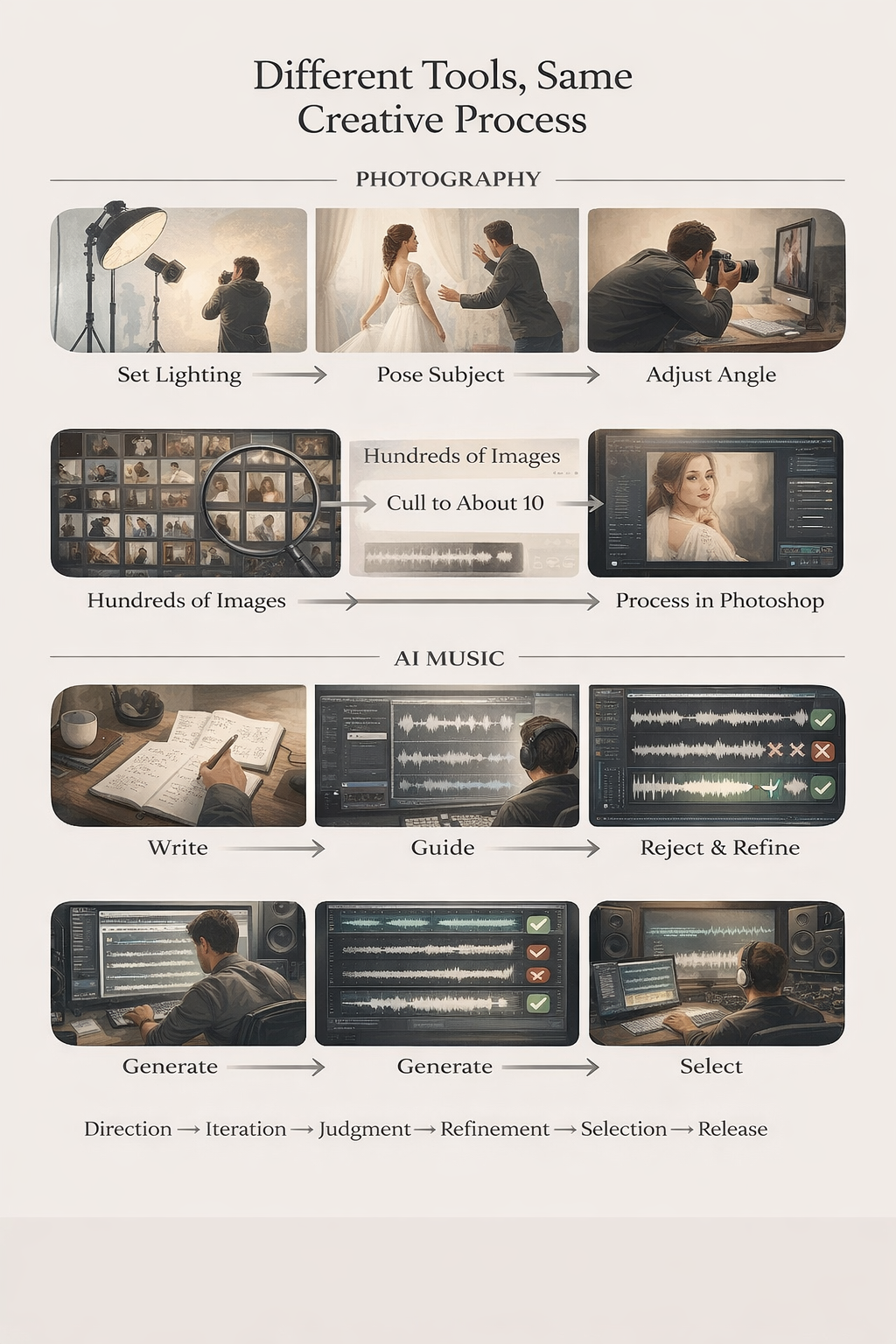
I would set my lighting, pose my subjects, adjust angles, move again, check hair, check shadows, shoot — over and over. I’d take a hundred images knowing only ten might be worth keeping.
Then I’d go home, load them into Photoshop, adjust exposure, contrast, sharpness, remove blemishes, clean dust spots. No one ever said the camera or the software made the photograph.
They understood authorship lived in:
- intention,
- iteration,
- rejection,
- judgment,
- and curation.
That same process applies to how I work with music tools now.
I write.
I guide.
I generate.
I reject.
I refine.
I select.
Out of abundance, judgment matters more — not less.
Authorship has never required touching every instrument or executing every step manually. A film director doesn’t operate the camera, act every role, or compose the score. No one claims they didn’t make the film.
Creative authorship lives in choice.
Drawing a clear line
I don’t use covers.
I don’t upload copyrighted material.
I don’t recreate specific songs or artists.
I create original work using modern tools — tools that understand musical structure the same way artists always have: by learning the language of the medium.
That distinction matters.
What is really bothering the art world
This conversation isn’t actually about whether machines can make art.
It’s about:
- consent,
- compensation,
- trust,
- labor value,
- and what happens when long-standing gatekeeping economics begin to crack.
Those are real concerns. They deserve real solutions.
But collapsing style into theft, similarity into guilt, and tools into moral failure doesn’t protect creativity.
It freezes it.
The truth worth standing on
There are only so many ways to light a face.
Only so many ways to arrange color on a canvas.
Only so many ways to make a chord progression feel like home.
Similarity is not proof of wrongdoing.
It’s proof we’re all speaking the same creative language.
That language has never belonged to one generation, one industry, or one set of tools.
It belongs to everyone who learns it, respects it, and uses it to say something new.
And that’s where I stand.